
Marble vs Granite: How to Choose, and Where Each Belongs
The choice is settled by chemistry, not taste: marble is reactive calcium carbonate, granite is inert quartz and feldspar. That single fact decides which stone goes in the kitchen and which belongs in the bathroom.
By Blue Azul Developers
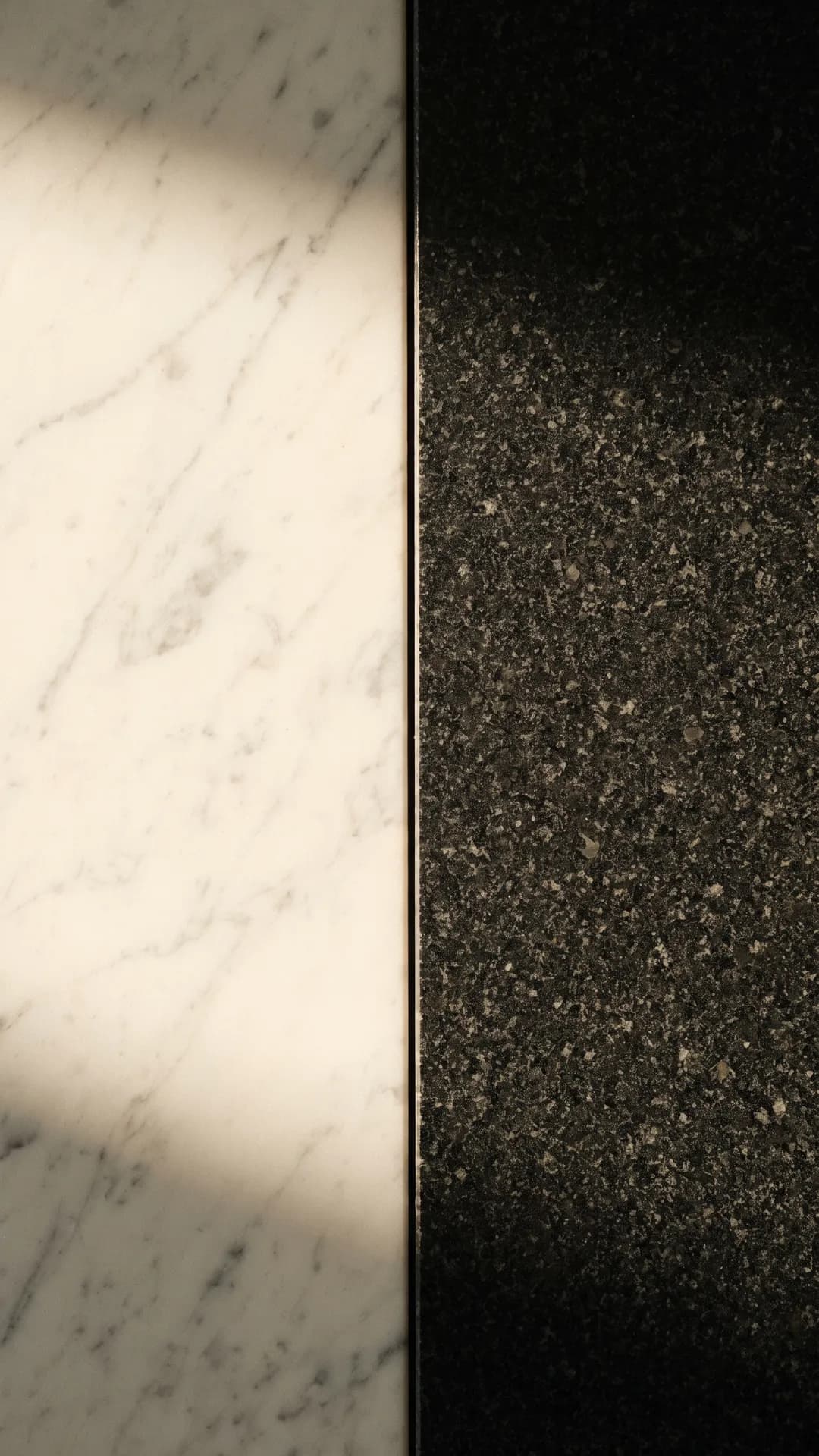
The decision rule is short: specify granite wherever a surface must survive acid, abrasion and daily work — kitchen worktops, heavy-traffic floors, thresholds and wet-area floors — and specify marble wherever light, veining and depth matter more than chemistry — bathrooms, walls, vanities and quieter floors. The difference that drives the rule is not porosity or even hardness alone; it is that marble is calcium carbonate and reacts with everyday acids, while granite is quartz and feldspar and does not.
Both stones are in the group's real-time materials library at /materials, as honed Carrara marble and honed granite — orbit the two spheres side by side and the difference in grain and light is easier to see than to describe.
What are marble and granite, geologically?
Marble is a metamorphic rock: limestone that has been recrystallised under heat and pressure into an interlocking mass of calcite — calcium carbonate, CaCO3 — with traces of clay, mica, quartz and iron oxides supplying the veining. That recrystallisation is what gives good marble its translucency: light travels a short distance into the calcite before returning, which is why a marble wall appears to glow rather than merely reflect.
Granite is an igneous rock: magma that cooled slowly, thousands of metres underground, over thousands to millions of years. The slow cooling grew the large, visible crystals of quartz and feldspar — with minor mica and amphiboles — that give granite its speckled grain. Nothing in that assembly is soft, and nothing in it reacts with anything found in a kitchen.
How do the two stones compare on hardness and durability?
Granite is decisively harder. Its load-bearing minerals sit at 6–7 on the Mohs scale — feldspar at about 6, quartz at 7 — above the hardened steel of a knife blade. Calcite sits at 3, and marble as a rock tests at roughly 3–4. In practice, granite resists scratching from knives, keys, grit and furniture; marble can be scratched by all of them, and a sandy shoe on a marble floor is an abrasive.
Durability is a broader question, and the record favours both: marble floors laid two thousand years ago are still in service. Marble does not fail, it wears — polish dulls along traffic lines, surfaces develop a patina — while granite barely registers domestic use. The honest distinction is that granite stays as installed and marble ages visibly; the specifier's job is to decide where visible ageing is a defect and where it is the point.
Why does marble etch — and can sealing prevent it?
Etching is a chemical reaction, not a stain. Calcium carbonate dissolves on contact with acid, so lemon juice, wine or vinegar removes a microscopic layer of the marble's surface. The etched patch scatters light instead of reflecting it and reads as a dull ghost that no cleaning removes — only re-honing or re-polishing does. Granite's quartz and feldspar are, for household purposes, chemically inert; the acid test is literally how geologists tell the two families apart.
No sealer prevents etching. Sealers are impregnators that slow the absorption of liquids into the stone's pores — they address staining, a different failure mode — while the acid–calcite reaction happens at the surface, above anything a sealer treats. It is the most misunderstood point in the whole decision: a marble worktop in a working kitchen is a commitment to patina, not a problem a product can solve.
Honed or polished: which finish for a premium interior?
Honed — ground to a smooth matte rather than buffed to a mirror — is the finish the group specifies, and both stones in the materials library are shown that way. The reasoning is practical before it is aesthetic: an etch mark is a matte spot, sharply visible on polished marble but all but invisible on a honed surface, and honed stone is less slippery underfoot, which matters for bathroom and pool-adjacent floors.
The aesthetic case follows. A mirror polish reflects the room; a honed surface returns light softly and lets the material — Carrara's grey veining, granite's mineral grain — do the work. Polished granite is the finish of the 1990s hotel lobby; honed stone is quieter, and quiet is harder to fake.
Where does marble belong, and where does granite?
Marble belongs where acids and abrasion are rare and light is the point: bathroom floors and walls, vanity tops, shower enclosures, fireplace surrounds, and low-traffic floors where shoes arrive without grit. Bathrooms are close to ideal — soap and water do calcite no harm, and honed marble in a wet room is one of the oldest luxuries in building.
Granite takes everything else: kitchen worktops, where citrus, wine and hot cookware are daily events; entrance halls and stairs, where grit underfoot is constant; thresholds, terraces and pool copings, where the stone must ignore weather as well as wear. Where the two meet — a kitchen that wants marble's light — the mature answer is to zone: granite on the working runs, marble on the splashback, island front or floor.
How do you care for each stone over decades?
Less than the folklore suggests. Both stones want pH-neutral cleaners — never vinegar or lemon-based products, on either stone — and spills wiped rather than left. Dense granites often need no sealing at all; where a sealer is warranted, a quality impregnator on either stone has a service life of ten to fifteen years, not the annual ritual the aftercare industry implies. A water drop that darkens the surface within minutes is the sign a reseal is due.
One number reverses the usual assumption: the ASTM dimension-stone specifications allow granite up to 0.40% water absorption by weight and hold marble to 0.20%. Sound commercial marble is not the sponge of popular imagination — its vulnerabilities are chemical and mechanical, not porous — which is why care is about what touches the surface, not how often it is sealed. Budget for a professional re-hone of marble floors on a cycle of years; expect granite to outlast every appliance in the building.
- Does marble stain easily?
- Less than assumed. Commercial-grade marble is held to a maximum of 0.20% water absorption under ASTM C503 — half the 0.40% the granite specification allows — so sound marble is dense. Its real weakness is etching: acids dissolve the calcite surface on contact, a chemical mark often mistaken for a stain. Wiped promptly, neither stone is fragile.
- Is granite harder than marble?
- Yes, by a wide margin. Granite's quartz and feldspar sit at 6–7 on the Mohs scale, above a steel knife blade; marble's calcite sits at 3, so marble tests at roughly 3–4. Granite resists everyday scratching; marble does not, which is why it suits walls, bathrooms and gentler floors.
- Do granite worktops need sealing?
- Often not. The Natural Stone Institute notes that most granite worktops do not need sealing, and where one is applied, a quality impregnating sealer lasts ten to fifteen years. Test with a drop of water: if it beads or sits without darkening the stone, the surface does not need treatment.
- Can you use marble in a kitchen?
- You can, if you accept the terms: splashes of lemon or wine will etch the calcite, sealers cannot prevent it, and the surface will develop a patina. A honed finish makes the marks far less visible. Where patina is unwanted, put granite on the working surfaces and marble where acids rarely land.