
Fair-Faced Concrete: The Structure That Is Also the Finish
What fair-faced concrete is, why casting the finish is harder than covering the structure, how quality is specified through classes such as SB 1–4, and why its thermal mass suits a hot climate.
By Blue Azul Developers
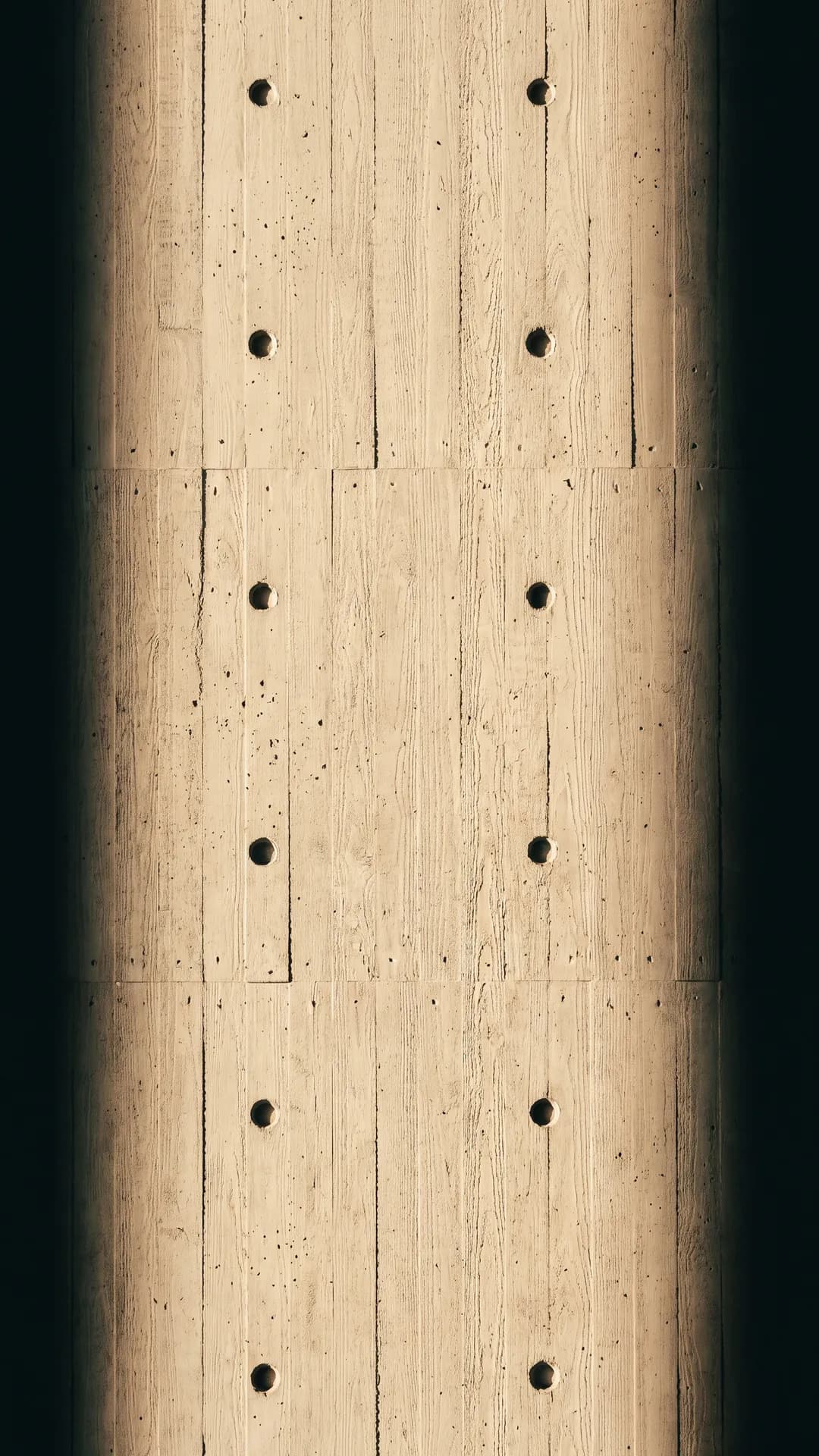
Fair-faced concrete is concrete cast to be the finished surface. The structure itself, struck from its formwork, is what you see — no render, no plaster, no cladding applied over it. Every decision taken before the pour, from the layout of the formwork panels to the position of each tie bolt, is recorded permanently in the face of the wall.
It is the material at the centre of Blue Azul's own visual language, and you can orbit a fair-faced concrete surface up close in our 3D materials library at /materials.
This article explains the term, why it demands more of the builder than covering the structure would, how quality is specified, and why its thermal mass makes particular sense in a climate like Cyprus's.
What is fair-faced concrete?
Fair-faced concrete — also called exposed, architectural or off-form concrete, and Sichtbeton in German — is structural concrete whose surface, exactly as it leaves the formwork, is the final architectural finish.
The formwork face determines everything the eye reads. Coated plywood gives a smooth, near-silken plane; rough boards leave the timber grain pressed into the surface; steel forms give a hard sheen. The joints between panels and the small round holes left by the tie bolts that held the forms together remain visible, so they are composed as part of the design rather than hidden.
The essential distinction is intent. Ordinary structural concrete is judged on strength alone, because it will be covered; fair-faced concrete must satisfy the engineer and the eye at once.
Why is it harder than covering the structure?
Because there is no second chance. Render and cladding conceal whatever happened during construction; fair-faced concrete records it, and the record cannot be edited without leaving a visible repair.
The discipline starts on paper. Formwork is drawn like a façade: panel sizes, joint lines and the tie-bolt grid are set out deliberately, since all of them will read on the finished wall. Tadao Ando's walls — cast against panels proportioned like tatami mats, each carrying its regular grid of six tie holes — are the canonical demonstration of that composition.
The pour must then be planned as carefully as the drawing. Concrete placed in interrupted lifts leaves a cold joint, a visible band across the surface; compaction must drive out air trapped against the form face; the mix must stay consistent from batch to batch; and curing must be controlled, because uneven drying shows later as uneven colour. None of this changes the strength of the wall — all of it changes its face.
How is the quality of fair-faced concrete specified?
Not with the words "fair-faced". UK guidance from The Concrete Society notes that the term is too subjective to specify against — advice that dates back to CP 110 in 1972 — so formal documents use defined finish classes instead: Basic, Ordinary, Plain and Special under BS EN 13670 and the UK's National Structural Concrete Specification.
German practice, widely referenced across Europe, grades exposed concrete into four classes, SB 1 to SB 4, established through the DBV/VDZ guidance on Sichtbeton. SB 1 tolerates slight variation in colour and texture; SB 2 requires an evenly coloured and textured surface; SB 3 a very even one with only isolated defects; and SB 4, the highest grade, an essentially uniform surface on which blowholes and efflorescence are barely tolerated.
Because appearance is judged by eye, good specifications tie the class to a physical benchmark — a full-scale sample panel cast with the same mix, formwork and crew before the real walls are poured.
What does it look like done well — and done badly?
Done well, the wall reads as a single calm plane: even in colour, tight-pored, with the panel joints and tie holes falling into a deliberate rhythm. Ando's buildings show the ceiling of the craft — concrete smooth enough to act as a neutral canvas on which daylight and shadow become the architecture.
Done badly, the same material catalogues its own construction failures. Blowholes — small cavities, usually under 12 millimetres — appear where air was trapped against the form face through insufficient vibration. Honeycombing, a coarse stony patch of voids, betrays leaking formwork joints or poor compaction around congested reinforcement. Colour variation arrives later, from inconsistent mixes, absorbent or reused formwork, or uneven curing; cold joints stripe the surface where a pour was interrupted.
None of these matter in a rendered wall, because render hides them. In fair-faced work they are permanent — which is precisely why the finish is read as evidence of workmanship.
Why do architects choose it — especially in a hot climate?
Aesthetics first: fair-faced concrete descends from the béton brut of post-war brutalism, refined by contemporary minimalism into something quieter — a material honest about its making, and an exceptional backdrop for strong sunlight, which is no small thing in Cyprus.
The practical case rests on thermal mass. Exposed concrete inside a building absorbs excess heat through the day and releases it overnight when the building is ventilated with cool night air — what the Global Cement and Concrete Association describes as a thermal flywheel, shifting the cooling load away from the hottest hours and reducing, sometimes eliminating, the need for mechanical cooling. In a Mediterranean climate of hot days and cooler nights, that daily cycle works in the building's favour.
Add durability and low upkeep — no paint systems to renew, no cladding fixings to inspect — and the structure and the finish share one service life.
How does fair-faced concrete age?
As a mineral surface, gradually and without needing rescue. Concrete's colour continues to settle for a year or two after casting as the surface dries and carbonates, generally becoming lighter and more even.
Outdoors, ageing is mostly a question of how water is managed. Well-detailed copings, drips and sills steer rainwater off the face so it weathers uniformly; poor detailing concentrates run-off into streaks. Hydrophobic sealers can slow water absorption and staining where exposure is severe, but they are a refinement, not a necessity.
Fair-faced concrete does not stay factory-new — it acquires a patina, and walls that were cast well wear it well. What it never demands is repainting or recladding, which is much of its appeal to anyone taking a long view of a building.
- Is fair-faced concrete the same as brutalism?
- No. Brutalism was an architectural movement that used raw, often board-marked concrete (béton brut) expressively; fair-faced concrete is a construction finish — concrete cast to be the final surface. Contemporary fair-faced work is usually smooth, pale and precise, closer to Tadao Ando's minimalism than to post-war brutalist texture.
- What are the small round holes in fair-faced concrete walls?
- They are tie-bolt holes, left by the rods that held the two faces of the formwork together against the pressure of wet concrete. In fair-faced work their positions are set out on a deliberate grid and left visible — or neatly plugged — as part of the composition rather than hidden.
- Is fair-faced concrete more expensive than rendered concrete?
- The casting itself costs more: higher-grade formwork, careful pour planning and skilled crews are all required because the surface cannot be corrected afterwards. But there is no render, paint or cladding to buy, and effectively no redecoration over the building's life, so the whole-life comparison is far closer than the initial cost suggests.
- Does exposed concrete make a house hot in summer?
- The opposite, when designed properly. Concrete's thermal mass absorbs heat during the day and releases it at night when the building is ventilated with cooler air, smoothing indoor temperatures and reducing air-conditioning demand — a documented benefit in hot climates with cool nights, such as the Mediterranean.